

The corporate promotion formula
Hard work is only one-third of what it takes to get promoted. The PIE framework changed how I show up.

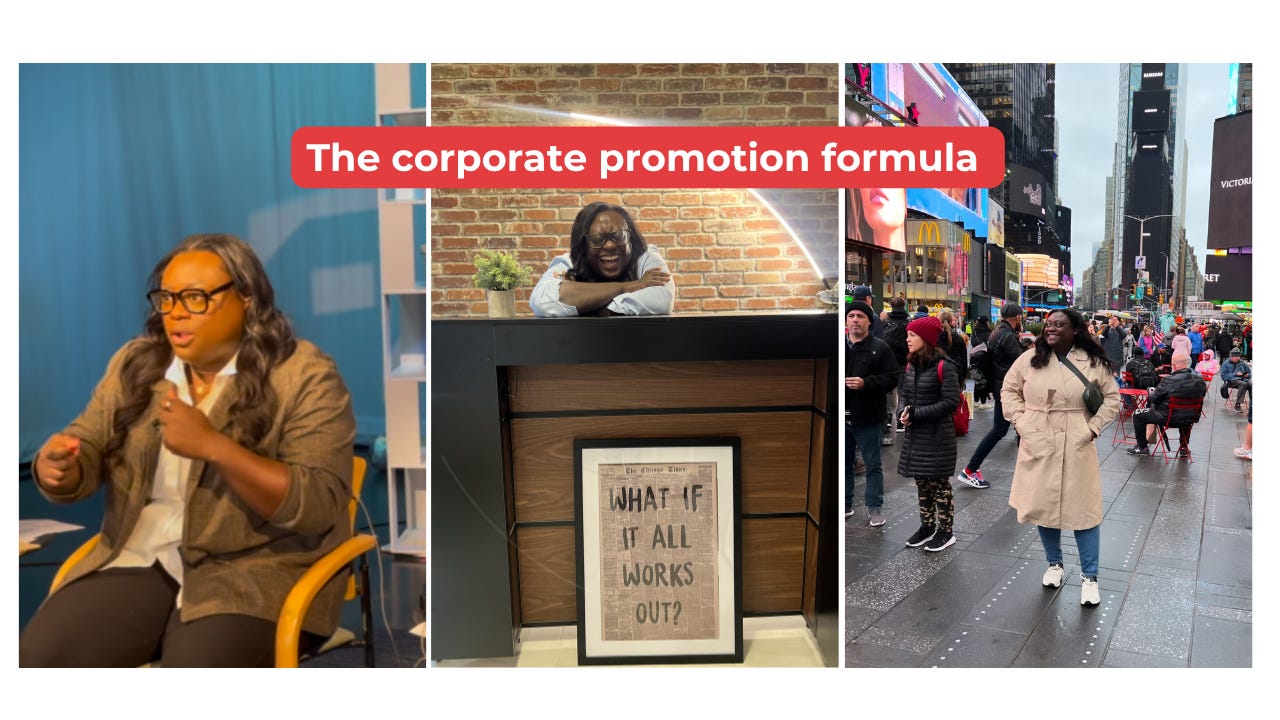
Happy Monday! You wouldn't believe the week I had last week. I was traveling for work — away from my baby for the first time — got about 2 tsps of sleep, and dropped my phone in the toilet. But the brand I was working with said I "exceeded their expectations," which means I'm now adding "works well under pressure" to my résumé. Anyway. I just want to thank everyone for reading and subscribing. Because of you, we're growing this community faster than I ever could have imagined.
Speaking of growth, that’s exactly what today’s topic is about. When I started my career, I was such a sweet, naive Millennial who used to think promotions were based on merit. Then I watched certain colleagues leap two levels ahead while I was still waiting for my “turn.” That’s when I realized there were rules to this game. I just didn’t know them yet.
TL;DR 👀
Do you want a piece of the PIE?
For the longest time, I believed in a pretty simple formula: work hard, deliver results, and get promoted.
As a young girl growing up in the projects, I thought it was best to keep my head down, work my ass off, and eventually, someone would notice and give me the kudos I deserved.
…And I don’t think I could have been any more wrong about that.
I learned this the hard way when I watched colleagues with similar performance metrics move up while I stayed exactly where I was. I wasn’t bitter about it or anything. I was genuinely confused. Like, what am I missing here?
Once I learned that there are unwritten rules for getting promoted, it was like I unlocked a secret code to the corporate world that nobody explicitly tells you about.
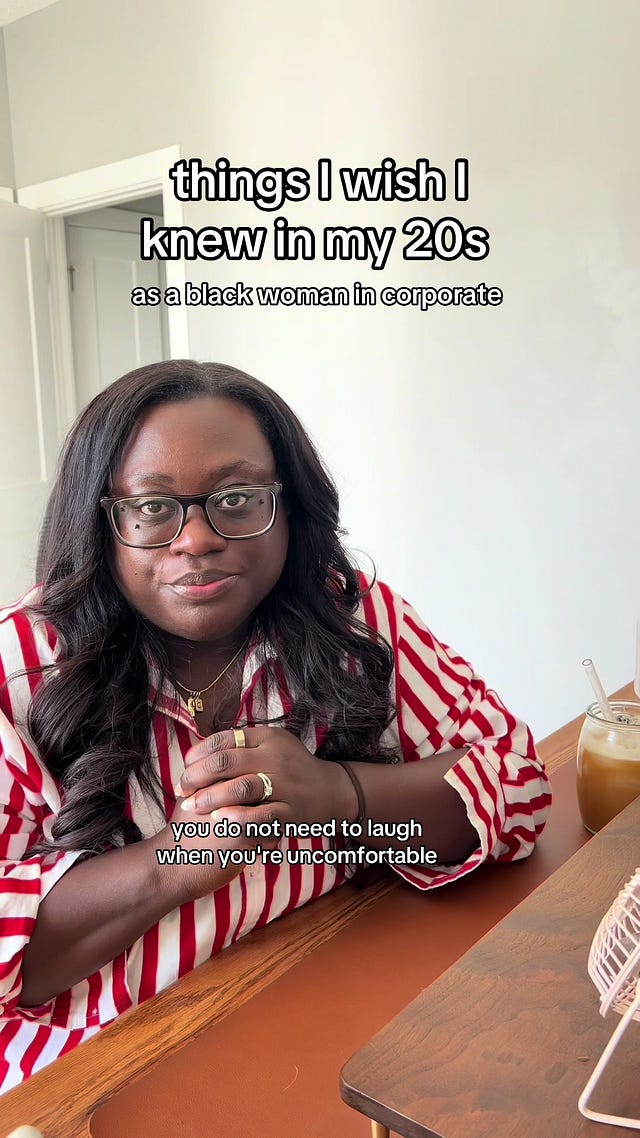
 Tiktok failed to load.
Enable 3rd party cookies or use another browser
It’s called PIE*— Performance, Image, and Exposure.
Yes, I know, it’s hard to believe: Performance is only one-third of the equation. And that’s where a lot of us, including myself at the beginning of my career, get it twisted.
Performance is the piece of PIE that most of us are familiar with.
Performance is what you deliver. It’s the actual work you’re assigned to take on, your output, and the results that come with it. This is where I had been overindexing hard.
I thought if I just hit 100% of my goals quarter after quarter, that would be enough to get me into the room where it happened. The tough lesson was that performance gets you in the game, but it doesn’t win it. And ironically, focusing on performance alone can burn you out the quickest.
The next part of PIE is image. Image can mean a lot of things, but in this case, it is how you’re perceived.
It’s your brand, your reputation, and the narrative people tell about you when you’re not present. Are you seen as strategic, or just tactical? A leader or an executor? Someone ready for the next level, or someone really good at their current one?
I hadn’t thought about this at all. I assumed my work would speak for itself, but here’s the thing — work doesn’t speak. People do.
Last but not least, there’s exposure, or who knows about your work and is talking about it. And I don’t mean just your direct manager, but their manager, their manager’s manager, and of course, the decision-makers who sit in promotion calibration meetings.
When I first started out, I delivered great work, sure. But I also worked in a vacuum that was visible only to my immediate team. Meanwhile, other people were presenting at All-Hands meetings, volunteering for speaking opportunities, working on cross-functional initiatives, and building relationships with executives, partners, and customers.
If someone had given me this framework earlier, I would have approached my entire career differently in the beginning.
I would have shared wins more broadly, instead of quietly checking boxes. I would have sought out high-visibility projects, not just high-impact ones buried in my department. I would have built relationships with leaders outside my direct reporting line and actually thought about how I wanted to be perceived.
So I started playing differently. I became a thought leader for the company, contributing to well-known publications for the PR team, co-hosting the brand podcast, and presenting at proprietary events for our customers.

I participated in high-value, external-facing initiatives, like a global customer experience group, overseeing three different functions: strategy consulting, customer insights, and training & enablement. And I did all this with seven direct reports, 14 indirect reports.
Because you can be the best performer on your team, hitting your KPIs every quarter, and still get passed over for that promotion or transition. If the right people don’t know who you are or can’t articulate why you’re ready for more, then you might as well be invisible.
It’s easy to assume that PIE is about playing politics or being inauthentic. But it isn’t. It’s about understanding that career advancement is a multi-player game with unwritten rules, and you can’t win a game you’re not even aware you’re playing.
So if you’re where I was, here’s my advice: Work hard AND make sure the right people know about it. Build your skills AND your brand. Deliver results AND create visibility around them.
Hard work absolutely matters. But it doesn’t speak for itself. You have to speak for it, too.

Building my personal brand changed my life.
Nine months ago, I left corporate. It definitely wasn’t in a “burn it all down” kind of way. I just…could, for the first time in my 15+ year career.
Here’s what having a personal brand actually gave me:
The ability to walk away from what doesn’t serve me
Control over how I spend my time (and what I charge for it)
A sabbatical I never could’ve swung before
Being fully present for my daughter, aka the only gig that’ll ever really matter
Now I’m building Sloefy™ to help other corporate folks, aspiring creators, and even experienced ones do this, too.
The waitlist just opened. (We literally haven’t announced this yet, but here I am spilling the tea. 😂)
If you’ve been thinking about building your brand but don’t know where to start, this is your sign.
That’s all for this week!
Once I figured out PIE, everything shifted. I got promoted time and again. But more importantly, I built enough leverage to walk away entirely.
Nine months into working for myself now, and even if I go back to corporate one day, I’m never playing by someone else’s rules again. That’s what understanding PIE does for your career.
Thanks for reading this edition of That’s a Monday Problem. I’ll see you for the next free issue on May 25th!
P.S. The PIE framework isn't mine — it comes from Harvey J. Coleman's Empower Yourself*. Highly recommend if you want to go deeper than I could here.